Sunday, 22 March 2020

Remembering Ernie - The Singing Pilot


Happiness was at the top of the agenda whenever Ernest “Ernie” Pace was around.  He was known for two things: making those around him laugh and singing.  Not just any old song but one song in particular: Dean Martin’s version of “Volare”. Originally written all in Italian it was subsequently performed by the Gypsy Kings in their native Spanish for all but the chorus which was left in Italian.  With the Dean Martin version all but the chorus – which again was left in Italian – was performed in English.  It was this version that became synonymous with Ernie. It was “his” song, a song everyone who knew and loved him associated with Ernie.

Also associated with Ernie was his beloved Cessna plane.  An accomplished Pilot with many flying hours under his belt, Ernie loved to fly; it was his passion. His fascination with flying began in the 1940s when, as a child, he would watch the planes fly over him on their way to war but it was not until tragically his 12-year-old son died following being run over by a bus and in the aftermath of such heartbreak his marriage broke down that Ernie pursued his dream in a bid to retain his sanity and he learnt to fly. He continued to fly until early into the 21st Century when due to his deteriorating eyesight he failed the medical but continued to feed his passion for all things flying related by the reading of books, magazines and watching films.

“Volare” quite literally translates as “Fly”, with the Italian lyrics translating to “…and I flew, I flew happily higher than the sun and even higher.”  It is with these words that his widow, Carol and son Anthony choose to remember him, having had them quite literally set in stone as they adorn his headstone, standing proud in York Cemetery. The Italian lyrics are beautifully inscribed in gold leaf around the bevel of the stone whilst the English translation is etched into the body of the stone. His Cessna plane is reverse carved onto the top of the stone.


Singing and laughing are not the only thoughts that spring to mind when remembering Ernie.  A technician by trade, having started his career working on T.V.’s with Granada, Ernie was fascinated by anything with movements.  He collected watches, clocks and anything else that had movements. At the time of his death, he had an estimated 500+ watches in his collection and many of his relatives and friends now own one or sometimes two of “Ernie’s timepieces”.  

Ernie choose to always wear two watches, one on each wrist. When asked why he wore two he would laugh and say: “So I can check each is right!”. When asked why he collected so many he responded: “Because time is the greatest gift you have.” This too is recognised on his memorial which is inscribed with the words: “Time passes, love remains.”

If you choose to seek out Ernie’s headstone in York Cemetery, pause for a moment and listen very carefully.  You may be surprised to hear and see a Cessna plane flying overhead.  Unless it’s Friday 13th. He would never fly on Friday 13th and that is the only day so far that anyone visiting his grave has not been aware of the plane flying over.  If you see and hear it you can guarantee that it will make you smile – because that is what Ernie, our Singing Pilot, does.


Friday, 13 March 2020

An Exquisite Place in York To Rest In Peace?


One of only two privately owned Victorian cemeteries in the UK today, York Cemetery dates back to 1837.  Far from being a sad place where people come to mourn the dead, it is an oasis of peaceful serenity and quite unique beauty.  Here the old sits alongside the new and wild plants and shrubs rub shoulders with beautifully manicured lawns and flower beds.

In parts, nature is almost reclaiming its own as ivy creeps up and over beautifully carved and weathered gravestones.  It is a mosaic of different areas within which one will find a section where angels watch over their charges, a herb garden where fresh herbs freely grow within the kerbs of the graves, a scented walk - specially planted with perfumed plants, butterfly walk - as the name suggests planted with shrubs to which butterflies are attracted, Soldiers Lawn, Belle Vue Terrace, Felicity Gate Wall and, of course, Emerson's Lawn all have been named with special meaning.

It hasn't always been so well-cared-for as it is today, however.  In 1966 it entered a period of voluntary liquidation, it wasn't until 1984 when York Cemetery Trust bought the cemetery for a nominal sum that the restoration work still taking place today began.  The following is an excerpt from "Reflections", written by and reproduced by the kind permission of Richard Keesing, Chairman of York Cemetery Trust, which is his personal account of what he found when he "discovered" the cemetery for the first time.

Reflections

"When I first clambered through a fence into the cemetery and wandered along its forgotten paths, the grounds were overgrown and everywhere there was a sense of the peaceful returning to nature.  I did not know how old or how extensive the burial ground was but all about me bore the cloak of nature reclaiming what was its own.  The inscriptions on the gravestones were weathered and were quietly being taken into care by the loving embrace of time.  I wandered through this silent land which seemed to have no beginning and no end.  The paths took their own mysterious ways and one was enfolded by the sounds of the silence and stillness of a late summer afternoon.  Every now and then I read an inscription on a tombstone which spoke of the sadness of the ending and the bearing away of a life into an unknown and unknowable land. And everywhere there was a cloak of mystery and a beauty which hung in the air as of the presence of the bearing away by angels.  And it seemed that the graves were enfolding me into a presence of delicate sadness and reassuring me that all would be well and that all manner of things would be well.

The cemetery is a place of mystical beauty, where its peace speaks of eternal values and asks one to leave, for the moment, the hustle and bustle of the world and find tranquillity and renewal in a place of endless, poignant sadness.  We have in our care a timeless land which has been here forever and will be here for time without end.  It offers to all a refuge and a place of quiet reflection upon the eternal values of life and of our beginning and of our passing onto eternity.  This land is of peacefulness, and of beautify and it is our bound and duty to do all that is in our power to enhance the mystery which it enfolds so that future generations can be held in it's protecting embrace.

...This land is sacred, for its beauty and tranquillity is born in sadness for the passing of a soul and the hope for the future of both the living and the dead.  Every inch of this beautiful and mysterious land is precious and all that we have done and all that we will do must help to enhance the presence of the eternal peace and mystery which is enshrined here so that all who come here can share in its peace and tranquillity...."

If you would like to become involved with helping to preserve this beautiful cemetery there are a number of ways in which to do this.  Please follow the following link to learn about the work of the Friends of York Cemetery: http://yorkcemetery.org.uk/friends-of-york-cemetery.html

Monday, 9 March 2020

A Hauntingly Beautiful Sight in York Cemetery

If ever a picture painted a thousand words then it must be one of the following, taken in York Cemetery this week.


What the photos reflect is the sheer beauty of a carpet of purple which has been created by the planting of 18,000 crocus corms at the cemetery.  The corms were planted as part of the "Purple4Polio" initiative created by Rotary International.  

In October 2018/2019 pupils from 3 local schools: St. Georges Primary, St. Lawrence's Primary and Fishergate Primary commenced the planting and on November task days planting was open to everyone and they were joined by 50 people of all ages, including the then Lord Mayor of York, Cllr. Barbara Boyce and the Civic Party.

As a founding partner of the Global Polio Eradication programme, Rotary International has helped to reduce polio cases by 99.9% since their first vaccination initiative was launched in the Phillippines in 1979.  Rotary International has helped to vaccinate over 2.5 billion children in 122 countries, having contributed more than $1.8 billion towards eradicating the disease worldwide.

Today, polio remains endemic in only Afghanistan, Pakistan and Nigeria although just 22 polio cases were confirmed worldwide in 2017 - which is a phenomenal reduction from the 1980s when the world witnessed around 1,000 cases per day.  

The significance of the colour purple and the strapline "Purple4Polio" is that when a child receives their life-saving polio drops on mass polio immunisation days in many countries their little finger is painted with a purple dye so it is clear they have received their life-saving vaccine.

The poignancy of the thousands of purple crocus in York Cemetery is that they have been planted in an area of small tombstones of babies and young children, which makes the beautiful sight all the more thought-provoking and such a hauntingly beautiful sight.  

Thank you to York Cemetery office for providing more information about the Purple4Polio initiative.  Further information and how you can make a donation can be found on the Rotary International website: https://www.rotary.org/en/our-causes/ending-polio

Wednesday, 4 March 2020

What A Way To Go!


I've always thought that a nice way to go when my time comes is in my sleep.  But what of these unfortunate and mostly untimely deaths?  How did they come to take their last breath?

*In 620 BC, an Athenian lawmaker by the name of Draco was smothered to death by gifts of hats and cloaks showered upon him by an appreciative audience in a theatre in Aegina!

In 455 BC another Athenian, this time a tragedian by the name of Aeschylus met an untimely death when an eagle dropped a tortoise on his bald head, mistaking it for a rock to shatter the hard shell of the reptile.  The irony of this was that Aeschylus was outside in order to avert a prophecy that he would be killed by a falling object!

In 1567 Hans Staininger, burgomaster of Bavaria (now Austria) met his demise when he broke his neck tripping over his own beard.  The beard was 4.5 ft long at the time and was normally kept rolled up in a leather pouch.

In 1872, a pallbearer at Kensal Green Cemetery in London named Henry Taylor stumbled over a stone whilst carrying a coffin.  The other pallbearers let go of the coffin and it fell on him, crushing him to death in front of all the mourners.

A few years later, in 1881 British MP Sir William Payne-Gallwey suffered internal injuries when he fell over whilst hunting, landing on a turnip.  He died a few days later from his injuries.

Frank Hayes, a 35-year-old jockey from New York only ever won one race, riding a horse named Sweet Kiss.  Sadly he suffered a fatal heart attack mid-race and collapsed on Sweet Kiss who still went on to win the race with his rider still on board meaning technically Frank won.

Health food fanatic and inappropriately named Basil Brown, 48, turned yellow and died after he consumed 70 million units of Vitamin A and 38 litres of Carrot juice over 10 days, damaging his liver.

In 1983, Dick Wertheim, a tennis linesman passed away after he was struck in the groin by a tennis ball and fell out of his chair!

Mildred Bowman, 62 and her sister Alice Wardle, 68 died whilst on holiday in Benidorm in 2005 when they became trapped for four days when their foldaway bed collapsed.

A 14 year old boy from China was killed when the pneumatic cylinder of his office chair exploded in March 2009.

A cow climbed on top of the house of Joao Maria de Souza, 45 of Brazil, from a steep hillside behind it. The cow fell through the roof, crushing Joao to death as he slept. Both the cow and de Souza's wife (who had been in bed next to him) were unharmed.

The stepson of Denver Lee St. Clair rendered him unconscious during a fight and then asphyxiated him with an atomic wedgie after he pulled the torn elastic band from his underwear over his head, using it to strangle him.

Most recently - on February 18th this year - Hoong Leong, aged 37 was struck on the shoulder by a falling gas cylinder whilst walking home during a storm in The Rocks area of Sydney Australia, he survived the impact but died of a cardiac arrest upon arrival at the hospital.

The moral of this post is: "Live each day as if it were your last. Learn as if you would live forever."  (Mahatma Gandhi).

*Facts courtesy of Wikipedia.

Tuesday, 3 March 2020

Keeping Up Appearances - Caring For Grandma

I never knew my paternal grandfather, he sadly passed away 8 years before I was born.  My grandmother "gran" however was a huge influence in my life, and to a large degree, she still is.

It has been alluded, more than once, that the TV character Hyacinth Bucket from "Keeping Up Appearances" was modelled on her.  I have several poignant and amusing memories of her: I can still see her walking to our local methodist chapel every Sunday, hat on, dressed in her "Sunday best", hymn book and the bible in hand.  She had her own, black, leather-bound hymn book with music scores and she was one of two organists, the other being Miss Pick, an elderly spinster of the village.  They took it in turns as to who would play each week.

My gran stood at less than 5' tall and her feet barely reached the pedals of the organ.  As she played she used to rock on the rickety organ stool in an effort to keep the bellows going and the organ playing.  Nonetheless, she played beautifully and had a real gift for music.  She never took her hat off during the service.  One week during a rather rousing rendition of Charles' Wesley's "And Can It Be That I Should Gain"  she actually fell off the stool.  All we in the congregation saw were her feet coming up from behind the organ, showing rather undignified her long lacey pantaloons that her generation still wore.  The hat rolled down the aisle.  Miss Pick was heard to say "Where has Mrs Lancaster gone?"  The singing continued, the Minister - a rather dour Rev. Ronald Cheffings - raised his eyebrows as my gran simply got up, righted the stool, retrieved her hat and then continued the hymn as if nothing had happened: "My chains fell off, my heart was free, I rose, went forth and followed thee...."

Gran's life had been touched by tragedy: my Auntie Anne sadly passed away from Kidney failure when she was only 20.  Within 6 short months, she had lost my grandad - who everyone said died from a broken heart.  I cannot begin to imagine the anguish she must have suffered from two such losses but I don't believe that the sense of loss ever left her.

She didn't drive but every week someone - latterly me or my mother - would drive her to the churchyard in the next village, 5 miles away from where they both had their final resting place.  There she would loving tend the graves, with fresh flowers and cleaning all being part of her routine.  On her deathbed, she asked that someone kept up the weekly routine but sadly, I had moved "down south" and mum was unable to fulfil her wishes every week.

The gravestone and that of my Auntie Mabel, in the same churchyard, quickly deteriorated without her care.  We thought there was nothing we could do to improve the state of them until I began my work at the stonemasons.  I quickly learnt that we have within our company incredibly skilled craftsmen with years of experience of renovating and restoring graves like those of my family.  

They say that pictures paint a thousand words so in this instance I'm going to let the photos speak for themselves.  I have to say I shed a little tear when I saw them because I knew my gran would be proud once more of the memorial she so carefully chose and looked after all those years.  


Before:


After:


Saturday, 29 February 2020

Live A Life Without Regrets


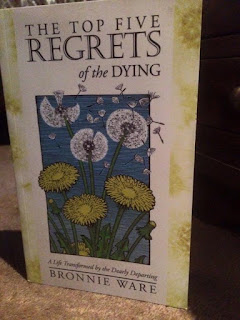
In her book, "The Top Five Regrets Of The Dying: a Life Transformed By The Dearly Departing"  author Bronnie Ware shares an insight into the top five regrets of the dying, based on her experience of several years working in palliative care, looking after people in the last 12 weeks of their lives.

It makes for very interesting reading as she discovered there were five "regrets" that were expressed many more times than others.  There was no mention of "I wish I'd lost more weight" "I wish I'd had more money"  "I wish I'd travelled more" or "I wish I'd had more sex" even!  No mention of the fast car they'd always wanted but never bought....or the house they'd always aspired to but never quite managed to buy.

The top five regrets of the dying are way more "basic" than the wish list above and all, without exception, are readily attainable by most of us:

1.  "I wish I'd had the courage to live a life true to myself and not that others expected of me."

The most common regret of all.  As their life was ebbing away from them, most realised that they had not fulfilled even half of their dreams.  This was due to choices they had made or not made - many to please others or because they felt it was what was expected of them.  Once their health began to deteriorate it was often too late.

2.  "I wish I hadn't worked so hard."

How many of us, this author included, are guilty of this? Work, work, work - sometimes, often, the work-life balance is out of kilter.  Long, working hours are spent away from the family we are working to support, milestones are missed as some of us become "busy fools".  Every male patient Bronnie nursed expressed this regret as they spoke of missing their children growing up and the companionship of their wife.

3.  "I wish I'd had the courage to express my feelings."

Many of Bronnie's patients suppressed their feelings in an attempt to keep the peace in their relationships, with an "anything for a quiet life" type mentality.  That is fine but often they developed illnesses directly related to the resentment they carried as a result.

4.  "I wish I had stayed in touch with my friends."

Everyone misses their friendships when they are dying.  Many express regrets about not keeping hold of and cherishing those golden friendships as they were just too busy.  Another day, week, month or year would pass without making a phone call, meeting up or keeping in touch.  Bronnie found often when her patients expressed a need to be in touch with their friends that they could not be traced.

5.  "I wish I had let myself be happier."

It sounds so simple, doesn't it?  Be happy.  Many of Bronnie's patients did not realise until the end of their life that they had a choice over whether to be happy or not.  They were stuck in old ways and habits which did not bring them happiness.  Fear of disruption or change left them pretending to others and themselves that they were content when deep down they longed to laugh properly and have silliness in their life again.

I find it fascinating that there are five common regrets.  How many of the above do you identify with?  It would be nice to think that the loved ones of anyone reading this post would be able to say, on your death: "They lived and laughed, loved and left."

Live a life without regrets - before it's too late.


A Monumental Muse

Muse

"As a verb, to muse is to consider something thoughtfully. As a noun, it means a person — especially a woman — who is a source of artistic inspiration." (Vocabulary.com Dictionary).


Everyday I deal with the aftermath of a death, and sometimes those who are dying, but, although the circumstances surrounding my work may be sad, my workplace is often filled with happiness and laughter as amusing incidents and characteristics of the person who has passed away are recalled and retold.


It helps to talk.  Not only does it help the family but it helps me to have an insight into a life well-lived.  The insight becomes a muse and the muse helps to create a memorial as unique and exquisite as the person to whom it is dedicated.


My office is set within the grounds of a beautiful Victorian cemetery.  It is a place of constant inspiration and I find myself choosing to wander amongst the graves, reading the inscriptions.  Musing (there it is again!) about the person who has passed away or the hand that has skillfully carved the stone, creating something beautiful beyond words. I can't help noticing how in parts nature is trying to reclaim the space, territorially wrapping its tendrils around an almost hidden stone.  It is a fascinating, peaceful place.  A place where you can rest for a while - or perhaps a little longer!


The cemetery has within its walls some beautiful memorials. Angels peacefully watch over those in their care.  Herbs grow within kerbs where they have been specially planted.  Walls reveal almost secret gates to the world outside, intricately shaped in wrought iron.  Butterflies abound, attracted to plants and shrubs grown specifically to become their habitat.  Standing in the middle of this is a Chapel, lovingly restored to its former glory.  It's a place you can celebrate the life of a loved one or choose to get married. 


The memorials I find myself visiting most often, however, are those which I have helped to create.  For these are the ones to which I feel the most connection as I stand and muse for a little while about how to live in the hearts of the people we leave behind is not to die.